When selecting an air cooler for a large industrial or commercial space, bigger isn’t always better.
A common misconception is that choosing the largest available air cooler automatically delivers the best cooling performance. In reality, an oversized or undersized cooler can result in uneven airflow, inefficient cooling, unnecessary energy consumption, and reduced overall comfort.
The right commercial or industrial air cooler is determined not just by the size of the room, but by how the space functions, how air moves through it, and the conditions in which it operates.
Whether you’re cooling a factory, warehouse, workshop, restaurant, banquet venue, or commercial facility, understanding the factors that influence cooler sizing can help you make a more informed investment.
Why Air Cooler Sizing Matters
An air cooler is designed to move and circulate large volumes of air.
If the unit is too small for the space:
- Airflow may not reach distant areas.
- Cooling can become uneven.
- Hot spots may remain throughout the facility.
- The cooler may have to operate continuously at maximum capacity.
On the other hand, selecting an oversized unit without considering the layout of the space may lead to inefficient air distribution and unnecessary operating costs.
The goal isn’t simply to cool a room—it’s to create consistent airflow across the entire area.
Step 1: Start with the Size of the Space
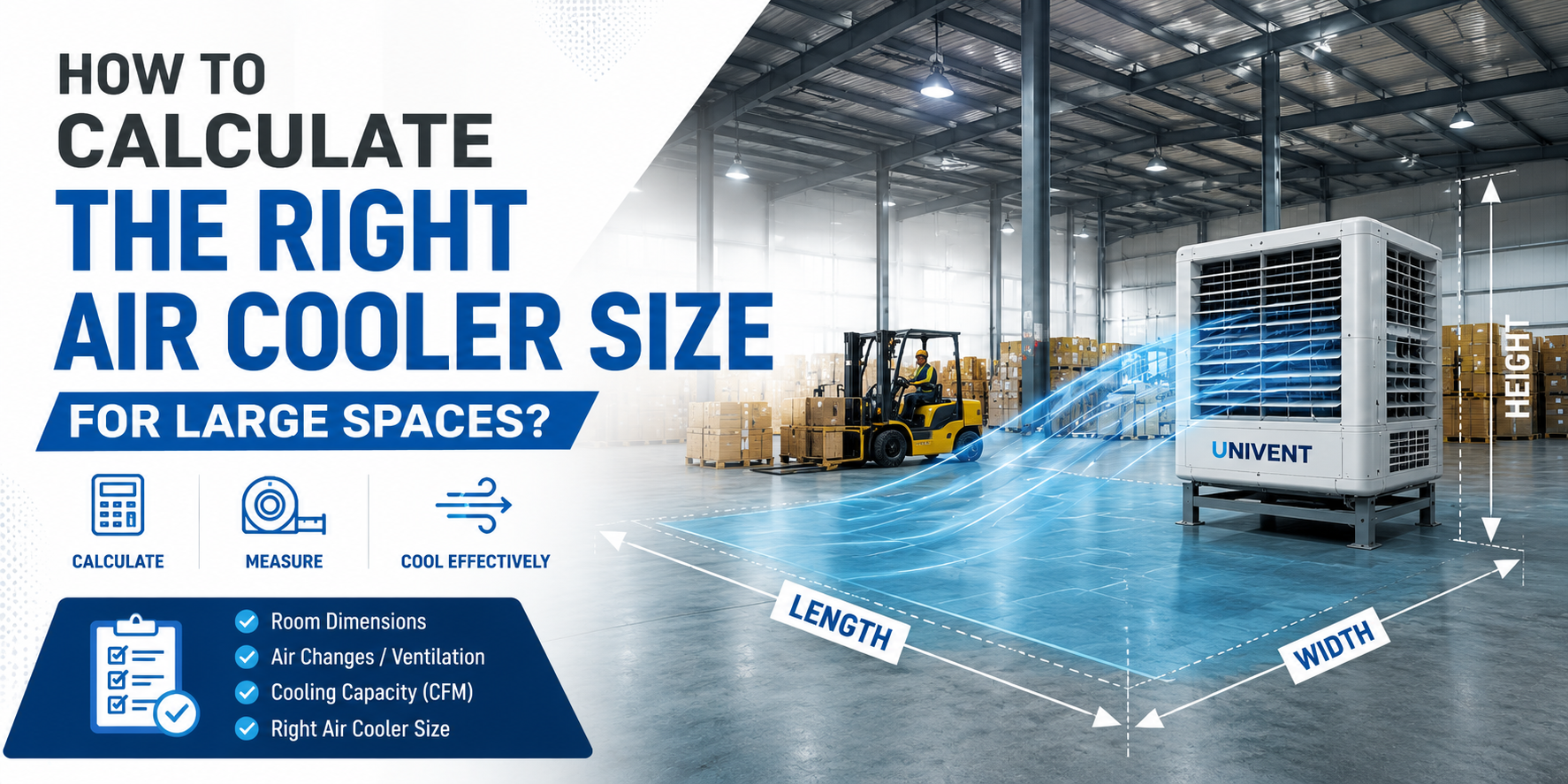
The first consideration is the physical dimensions of the area.
Measure:
- Length
- Width
- Ceiling height
This provides the total volume of the space rather than just the floor area.
For example, two facilities with the same floor area may have completely different cooling requirements if one has a significantly higher ceiling.
Large warehouses, production halls, and commercial venues often require cooling solutions designed to circulate air across much greater volumes.
Step 2: Understand How the Space Is Used
Every commercial environment behaves differently.
Consider questions such as:
- Is it a manufacturing plant with heat-generating machinery?
- Is it a warehouse with constant movement of goods?
- Is it a restaurant with fluctuating customer occupancy?
- Is it a banquet venue used only during events?
- Is it an open workshop with frequent access to outdoor air?
The function of the space often has a greater impact on cooling requirements than its dimensions alone.
Step 3: Evaluate Airflow Requirements
One of the most important specifications when choosing an industrial air cooler is air delivery, typically measured in cubic metres per hour (m³/hr).
Air delivery indicates how much air the cooler can circulate within a given time.
Higher air delivery generally makes a cooler more suitable for:
- Large workshops
- Factories
- Warehouses
- Restaurants
- Banquet halls
- Commercial gathering spaces
However, air delivery should always be matched to the characteristics of the space rather than considered in isolation.
Step 4: Consider Air Throw Distance
Air throw refers to how far the cooled air can effectively travel.
In large open spaces, this becomes particularly important.
A facility may have sufficient air delivery but still experience uneven cooling if the airflow cannot reach distant workstations or seating areas.
Wide air throw helps maintain better air circulation across larger environments, reducing warm zones and improving overall comfort.
Step 5: Assess Occupancy Levels
The number of people using a space directly influences cooling requirements.
For example:
- A warehouse with limited personnel has different needs than a banquet venue filled with hundreds of guests.
- A restaurant during lunch service generates more heat than the same space during preparation hours.
- Manufacturing facilities operating multiple shifts may require cooling for extended periods throughout the day.
Higher occupancy generally requires stronger and more consistent airflow.
Step 6: Identify Internal Heat Sources
Not all heat comes from the weather.
Industrial facilities often contain:
- Production machinery
- Ovens
- Compressors
- Motors
- Electrical equipment
- Lighting systems
These contribute significantly to indoor temperatures.
Commercial spaces may also experience additional heat from kitchen equipment, lighting, and high visitor traffic.
Accounting for these internal heat sources helps ensure the selected cooling solution can handle real operating conditions.
Step 7: Consider Ventilation
Air coolers perform most effectively in spaces with good ventilation.
Fresh air circulation allows warm air to exit while cooler air continues moving through the facility.
Before selecting a commercial air cooler, evaluate:
- Doors and openings
- Windows
- Exhaust systems
- Cross ventilation
- Overall airflow pathways
Proper ventilation enhances cooling efficiency and supports more consistent performance.
Choosing the Right Capacity Isn’t About One Number
Many buyers look for a single formula or room-size chart that tells them exactly which air cooler to purchase.
While room size is an important starting point, it tells only part of the story.
The right cooling solution is determined by a combination of factors:
- Floor area
- Ceiling height
- Air delivery
- Air throw
- Occupancy
- Heat-generating equipment
- Ventilation
- Nature of operations
- Operating hours
Looking at these factors together results in a cooling solution that performs more effectively over the long term.
Common Mistakes When Sizing Air Coolers
Businesses often make avoidable mistakes when selecting cooling equipment.
Some of the most common include:
- Choosing solely based on water tank capacity
- Comparing products only by price
- Ignoring ceiling height
- Overlooking ventilation
- Selecting a single unit for multiple disconnected spaces
- Focusing on air delivery without considering air throw
- Underestimating future expansion requirements
A well-planned cooling strategy considers the entire environment rather than individual product specifications.
Think Beyond Today’s Requirements
Facilities evolve over time.
Production lines expand. Warehouses increase storage capacity. Restaurants add outdoor seating. Event venues host larger gatherings.
When planning commercial or industrial cooling, it’s worth considering not only current requirements but also how the space may be used in the years ahead.
A cooling solution that supports future operational needs can reduce the need for frequent upgrades and provide greater long-term value.
Finding the Right Cooling Solution
Choosing the correct air cooler size isn’t simply about selecting the biggest model—it’s about understanding the environment you’re cooling.
A well-matched industrial or commercial air cooler delivers efficient airflow, consistent comfort, and reliable performance while supporting the day-to-day demands of your facility.
At UNIVENT, we understand that every industrial and commercial space has unique cooling requirements. Our range of commercial and industrial air coolers is engineered to deliver powerful air circulation, reliable performance, and efficient cooling across a variety of large environments—from factories and warehouses to restaurants, hotels, banquet venues, and commercial facilities. By matching the right cooling solution to the right application, businesses can create spaces that remain comfortable, productive, and prepared for every season.
FAQs
How do I choose the right air cooler for a large industrial space?
Consider factors such as floor area, ceiling height, air delivery (m³/hr), air throw, ventilation, occupancy levels, and internal heat sources rather than relying on room size alone.
Is a bigger air cooler always better?
No. An oversized cooler may not distribute airflow efficiently, while an undersized one may struggle to cool the space effectively. The ideal solution depends on the specific application.
What is air delivery in an air cooler?
Air delivery, measured in m³/hr, indicates the volume of air the cooler can circulate in one hour. Higher air delivery is generally better suited for larger commercial and industrial spaces.
Why is ventilation important for air coolers?
Air coolers work best when fresh air can enter and warm air can exit the space. Good ventilation improves cooling efficiency and helps maintain consistent airflow.